
Manufacturing overseas? Learn how small and mid-sized businesses can prevent defects, delays, and wasted shipments through effective quality control in China.
Executive Summary
If you’ve ever waited three months for a shipment only to discover your “premium” product looks like it survived a bar fight, welcome, you’re in good company.
For small and mid-sized businesses (SMBs), manufacturing in China is both a rocket booster and a minefield. The difference between scaling profitably and hemorrhaging margin often comes down to one thing: Quality Control.
This guide explains how to stop gambling with your pallets & containers and start managing your Supply Chain Risk like a pro with tools, standards, and a bit of humor earned the hard way.
1. Why Quality Control in China Matters for SMBs
Direct Takeaway: Every defect shipped is a one-way ticket from “fast growth” to “customer service meltdown.”
China manufactures over 28% of the world’s goods (World Bank, 2023). But that abundance also means enormous variance, from world-class precision shops to “my cousin runs the night shift” operations.
The SMB Reality:
- You don’t have a regional QA team in Shenzhen.
- You find out about problems after they arrive and usually from your angriest customer.
- You’re stuck between regulatory compliance on one side and margin pressure on the other.
- And your “we’ll fix it next run” turns into six weeks of rework, air freight bills, and a quiet existential crisis.
Without structured Quality Assurance Best Practices, even honest suppliers will make “creative” choices under pressure. And creative is rarely what you want when your name’s on the box.
2. The Anatomy of Quality Control in China
Direct Takeaway: QC isn’t a one-day event, it’s a lifestyle.
Quality control spans pre-production, in-process, and post-production. Done right, it aligns with Regulatory Standards (ISO, CEN, ASTM) and ensures your product doesn’t just look right, it behaves right.
The Three Pillars of QC:
- Supplier Qualification & Factory Audits
A Factory Audit is your first defense against wishful thinking. It checks whether your supplier’s machines, systems, and ethics are real not PowerPoint-deep. Companies that audit suppliers annually see up to 60% fewer nonconformance issues (SGS, 2024). - In-Process Inspections (IPIs)
Think of these as your “mid-semester report cards.” Using AQL inspections at 20% and 80% production lets you catch problems before they graduate into disasters. - Pre-Shipment Verification & Documentation
Final inspection isn’t a formality; it’s the difference between your goods arriving ready for retail or ready for recycling. Pair that with supply chain compliance documents and smart freight forwarding, and customs will love you.
Call-Out: The 3-Question QC Gut Check
- Has your supplier passed a Factory Audit in the last 12 months?
- Do you have AQL Inspections at multiple stages?
- Can you prove it with photos before you pay?
If not, you’re not managing risk — you’re sponsoring it.
3. What Goes Wrong: The Greatest Hits
Direct Takeaway: Most QC failures start with optimism and end with air freight.
| Stage | Where It Falls Apart | The Aftermath |
|---|---|---|
| Design for Manufacturing (DFM) | Specs too vague or tolerances undefined | “It looked perfect in CAD” syndrome |
| Supplier Onboarding | No engineering outsourcing or validation | Surprise subcontractors you didn’t know existed |
| Sampling & Pilot Runs | Skipped rapid prototyping | Design flaws found during mass production, ouch! |
| Mass Production | Weak supplier management or bad incentives | Quality fades faster than your patience |
| Shipping & Customs | Misfiled tariffs and sourcing strategy | Shipments held hostage at the port of “almost there” |
According to Deloitte (2024), 47% of SMBs faced quality-related delays last year — each costing an average of $38,000. That’s not “the cost of doing business.” That’s the cost of not checking.
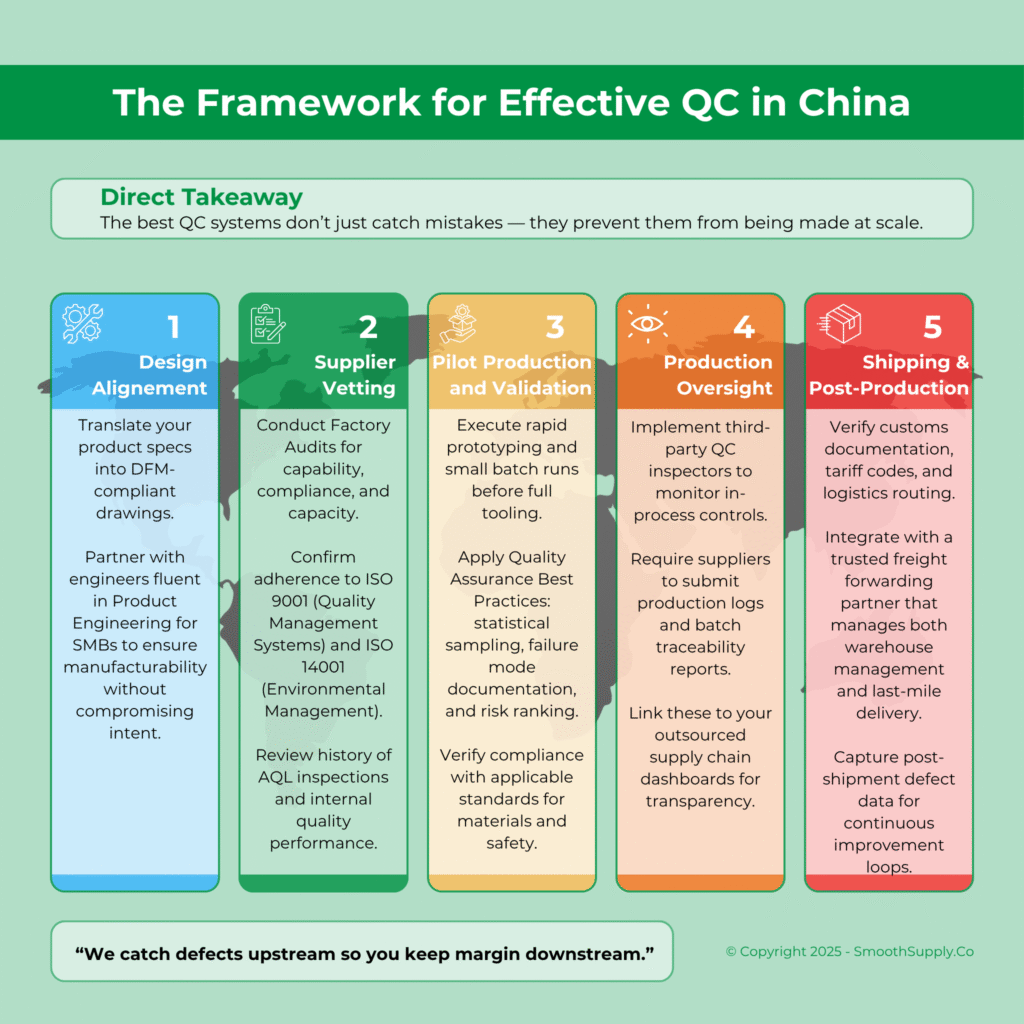
4. The Framework for Effective QC in China
Direct Takeaway: The best QC systems don’t just catch mistakes, they prevent them from being made at scale.
Phase 1: Design Alignment (DFM & Engineering)
Your DFM process should read like a prenup: everything defined, nothing assumed. Partner with experts in Product Engineering for SMBs who can translate Western designs into Chinese manufacturing reality.
Phase 2: Supplier Vetting
A Factory Audit is not a vibe check. It’s proof your supplier can deliver consistently, complies with ISO 9001, and won’t substitute your stainless steel for “something shiny.”
Phase 3: Pilot Production & Validation
Run rapid prototyping tests. Document every Quality Assurance result. Confirm compliance with ASTM or CEN standards before investing in full molds.
Phase 4: Production Oversight
Use independent inspectors, your “boots on the factory floor.” Link their findings to your dashboard for real-time visibility.
Phase 5: Post-Production & Shipping
Verify tariff codes, freight forwarding, and warehouse management before anything moves. Because once it’s on the ocean, your leverage floats away too.
5. How SMBs De-Risk Without Blowing the Budget
Direct Takeaway: Inspection isn’t about checking everything it’s about building systems so you don’t have to.
Three Moves that Work:
- Partner Smarter:
Choose contract manufacturing partners with embedded QC and verified supplier management. The result? Fewer surprises and fewer “urgent Zooms.” - Digital Oversight:
Implement remote audits, photo evidence, and AI-based reporting. You’ll feel like you’re in the factory without the jet lag. - Make It Sustainable:
Blend eco-friendly supply chains, ethical manufacturing, and sustainable manufacturing into your QC policy. Your investors will call it ESG. You can call it common sense.
Case in Point: A U.S. medtech SMB cut its defect rate by 83% in six months after implementing hybrid on-site/remote inspections tied to ISO 13485. Bonus: morale improved when they stopped overnighting replacement parts.
6. Measuring the ROI of Quality
Direct Takeaway: Quality doesn’t cost — it compounds.
| Metric | What It Means | Typical Improvement |
|---|---|---|
| First-Pass Yield (FPY) | Units passing first inspection | +25–40% |
| On-Time Delivery (OTD) | Orders shipped as promised | +15–20% |
| Cost of Poor Quality (COPQ) | Scrap + rework + warranty | –30–50% |
| Return Rate | Customer returns | –40% |
| Gross Margin Lift | From better control | +5–10 pts |
(Source: PwC 2024; McKinsey 2023)
In short: better QC = fewer apologies + better margins. That’s math everyone can enjoy.
7. The QC Readiness Framework™
Direct Takeaway: You can’t manage what you don’t measure. Start here.
The 5-Question Quick Test:
- Do we have a Product-to-Market Strategy with QC gates built in?
- Are our suppliers vetted for both quality and ethics?
- Are we audit-ready under international standards?
- Are we tracking data that drives cost reduction for SMBs?
- Can we prove our QC system supports scaling small businesses?
Two or more “no” answers? You’re not scaling you’re gambling.
Conclusion
Quality Control in China isn’t about distrust it’s about design. It’s how growing companies turn volatility into velocity, and how good suppliers become strategic partners.
The best SMB leaders treat QC as insurance for their brand, not paperwork for customs. Because in global trade, reputation travels faster than freight.
So audit early, inspect often, and remember: hope is not a quality plan.


